Authentication
How to authenticate memorabilia
Three checks worth doing before you spend anything, and the one almost everybody skips.
Authentication
Three checks worth doing before you spend anything, and the one almost everybody skips.
Key takeaways
Signed sports memorabilia is one of the few categories where the thing you are paying for cannot be seen. A shirt is a shirt. What you are actually buying is the claim that a particular person held a pen against it, and the evidence that claim rests on.
That evidence is checkable, and most of it can be checked before you spend anything. What follows is the order we work through, and it is the same order we would recommend whether you are buying from us or from somebody else entirely.
The question is not whether a certificate exists. Almost every listing has one. The question is who issued it, and whether that name means anything outside the listing you are reading.
Three names run public registers. JSA, PSA/DNA and Beckett each publish a lookup where the number printed on a certificate can be typed in and checked by anybody. If the authenticator has a register, the certificate is verifiable. If they do not, it is an assertion.
A certificate issued by the seller is not evidence. It is stationery. A seller vouching for their own stock is the same arrangement as no authentication at all, dressed up to look like something.
Watch for names designed to look familiar. The category attracts authenticators whose names sit a letter or two away from the established ones. If you have not heard of them, search the name on its own and see what comes back.
Stock photography is the clearest warning sign in this category. If the listing shows a generic image of that shirt rather than the specific piece with its own creasing, fading and signature placement, there is nothing to compare against when the parcel arrives.
Ask for the item photographed with its certificate. One frame, both objects. A seller who holds both will send it within the hour. A seller who does not will explain at length why they cannot.
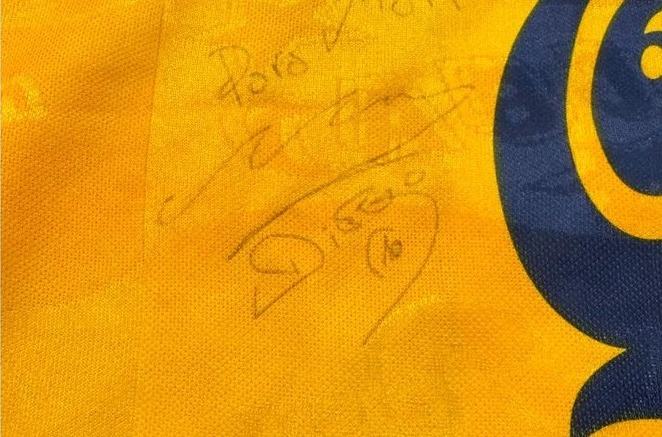
Ask for a close photograph of the signature. Not the whole shirt. The signature, filling the frame, in reasonable light. Ink behaves differently on fabric than on paper, and a macro shot tells you a great deal about whether a signature was applied to the material or printed into it.
Compare against the listing when it arrives. The creasing should match. The signature should sit in the same place. This takes thirty seconds and is the only moment where you can still do something about it.
Provenance is the check almost everybody skips, because it is the one that takes work to answer and the one sellers are least prepared for.
It does not have to be glamorous. A signing event with a date. An invoice from a previous owner. A named consignor. What matters is that something exists outside the seller's own account of events.
Be suspicious of stories without paper. A compelling narrative about how a piece was acquired is not provenance. It is marketing. The two are easy to tell apart: one of them survives being asked for a document.
Understand what provenance does not cover. Knowing where an item came from does not confirm the signature. The two questions are separate and both need answering.
Match worn is not the same as match issued. A match worn shirt was on the pitch. A match issued shirt was prepared for a player but may never have been used. Both are collectible. Only one commands the price people assume.
Retail is not a dirty word. A retail shirt signed in person at an event is a perfectly good piece, honestly described. The problem is only ever when it is presented as something else.
Race used, game used and replica are three different things, and in motorsport particularly the gap in value between them is enormous. Ask which one you are looking at in plain words, and ask what evidence supports it.
Age shows, and that is not a fault. A shirt from the nineties should look like a shirt from the nineties. Marks, fading and small repairs are normal and should be photographed rather than cropped out.
Signature fade is the one to ask about. Ink on fabric lightens over decades, particularly under light. A seller should tell you how a piece has been stored and whether the signature has faded from its original state.
Beware of listings with no flaws at all. Either the piece is genuinely mint, in which case it will be priced that way and described in detail, or the photographs are not telling you everything.
Verify the certificate number yourself. Open the authenticator's register, type the number, confirm the description matches. Under a minute, and it is the single most useful thing you can do.
Get the description in writing. Who signed it, what it is, what certification it carries, what condition it is in. If any of that turns out to be wrong, a written description is what gives you recourse.
Understand the returns position before, not after. Many sellers in this category treat signed items as final sale. Know which you are dealing with while you still have a choice.
Run these checks in order and most problem listings fall over at the first one. If a seller cannot name the authenticator, there is no point asking about provenance.
None of this requires expertise. It requires asking four questions and being willing to walk away when the answers are vague. The sellers worth buying from will answer all four without hesitation, because they had to answer them themselves before they bought the piece.