Certificates
What a certificate does not prove
How to verify a PSA, JSA or Beckett number yourself, and the limits of what it tells you.
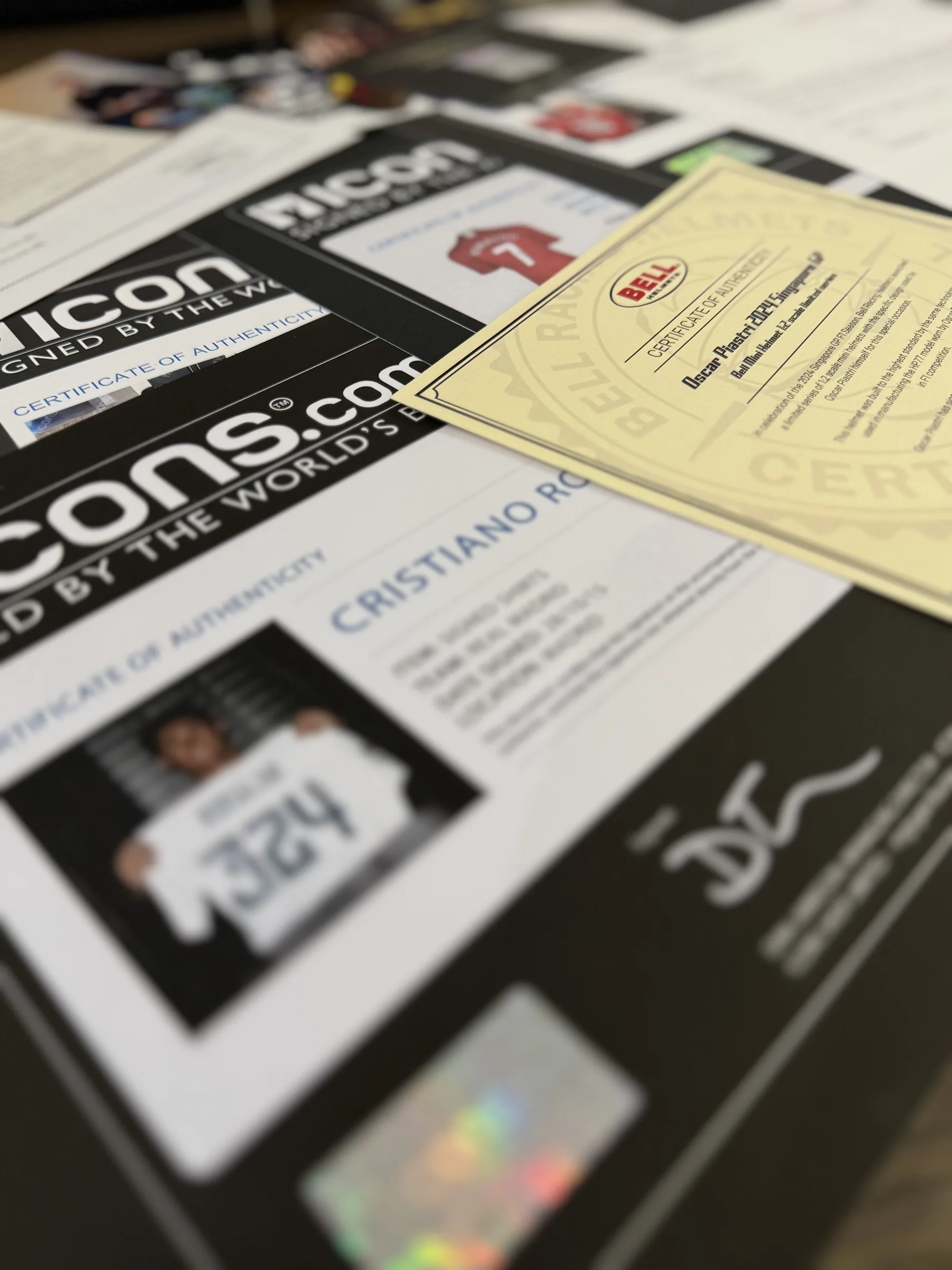
Certificates
How to verify a PSA, JSA or Beckett number yourself, and the limits of what it tells you.
Key takeaways
A certificate of authenticity carries more weight with buyers than it deserves, and less weight than it could. Most people treat it as proof. It is not proof. It is an opinion, recorded and numbered, and its value depends entirely on whose opinion it is.
Understanding what a certificate does and does not cover is the difference between buying carefully and buying hopefully.
It is one company's judgement, written down. An authenticator examined a signature, compared it against examples they hold, and formed a view. That view was recorded against a number.
Its worth depends on the name on it. An opinion from a company with twenty years of exemplars, a reputation to protect and a public register is worth a great deal. An opinion from a name that exists only on the certificate is worth nothing at all.
It is not a guarantee. Authenticators are careful about this in their own terms, even where sellers are not. They are giving you their assessment, not insuring you against being wrong.
JSA, PSA/DNA and Beckett all publish a lookup. Find the authenticator's own website, find their verification page, type the number from the certificate.
You should see the item described back to you. Not just a confirmation that the number exists, but a description that matches what you are being offered. A number that returns a different item is as much of a problem as one that returns nothing.
Do it before you buy. It takes under a minute. It applies to us as much as to anyone else, and any seller who objects to you checking has told you something useful.
If there is no register, ask why. Some legitimate authenticators do not run public lookups. In that case the certificate is only as good as your ability to contact them directly, so ask how that would work.
Where the item came from. A certificate addresses the signature. It says nothing about the shirt, the helmet or the ball it is written on, and nothing about how either came to be in the seller's hands.
Whether it was worn, used or raced. Authentication of a signature is not authentication of provenance. A signed retail shirt and a signed match worn shirt can carry identical certificates and differ in value by a factor of ten.
That the photograph is of this piece. A certificate number and a photograph are separate claims. The only thing that connects them is the seller, which is why a photograph of the item together with its own certificate matters so much.
That nothing has changed since. Certificates are issued at a point in time. Items are subsequently stored, handled, cleaned, reframed and occasionally altered. The paper does not update itself.
A manufacturer certificate confirms the object, not the signature. When Bell issues a certificate with a scale helmet, they are confirming that it is genuinely theirs, built to their specification, part of a particular series. That is a real and useful statement.
It is not signature authentication. If that helmet also carries an autograph, the autograph needs its own evidence from somebody whose job is examining signatures.
Both can be present. They are not interchangeable. Anyone presenting a manufacturer certificate as proof that a signature is genuine is either confused about the distinction or relying on you being.
Grading applies mainly to trading cards, and it assesses condition rather than authenticity, although the major graders authenticate as part of the process.
A grade is a number about corners, centring, surface and edges. It tells you how well an object has survived. It is not a statement about what the object is.
A slab is not automatically a guarantee. It is a sealed holder with an assessment attached. The same questions about who assessed it and whether that assessment can be looked up still apply.
The authenticator is named, not implied. Not "comes with COA" but the actual company, stated plainly.
The number is on the listing, not supplied afterwards. A seller confident in their paperwork publishes the reference where you can check it before any money moves.
The certificate is photographed with the item. One frame, both objects, so the connection between them is not something you have to take on trust.
The description is specific about what is and is not covered. A seller who tells you a shirt is signed but not match worn is being more useful to you than one who leaves it ambiguous.
None of this means certificates are worthless. A certificate from a serious authenticator, with a number you can verify, photographed alongside the item it belongs to, is strong evidence and should be treated as such.
It means a certificate answers one question well and four questions not at all. Knowing which is which is most of what separates a confident buyer from a hopeful one.